
Organisations collect more data than ever. Retention schedules, privacy policies and rules may define how long information should remain available. Yet when an old or rarely used dataset reaches the end of its operational life, one question often remains unanswered: who decides whether it should be retained, degraded or deleted?
Data often remains because nobody initiates a review, no single role knows where all copies exist, or the immediate risk of deleting something useful appears greater than the risk of postponement. Yet postponement also creates consequences, including growing privacy and security exposure, unnecessary management costs and continued reliance on data whose relevance is unclear.
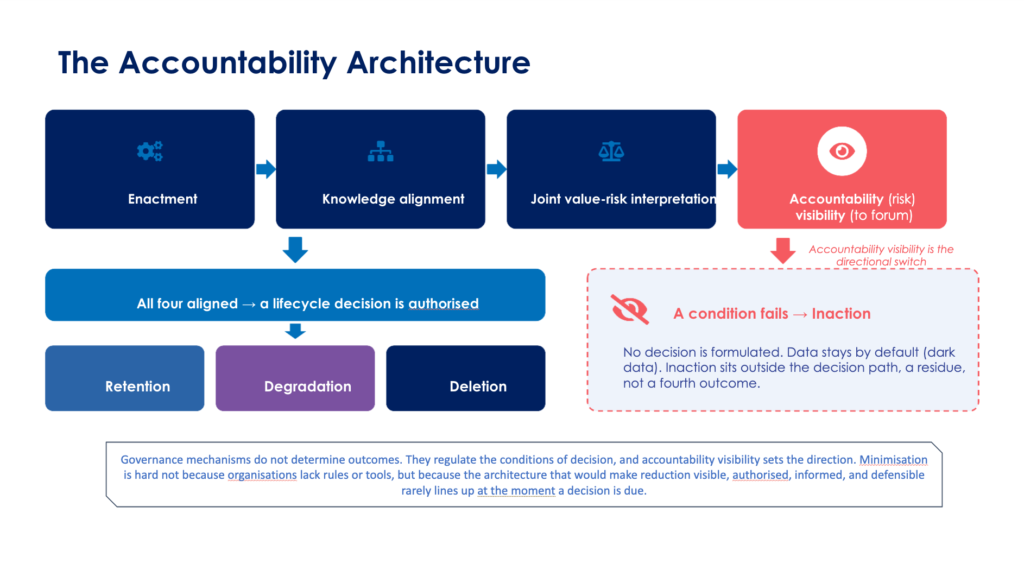
Based on research into Data Lifecycle Governance, we developed the Accountability Architecture: a practical framework for understanding why decisions about retaining, degrading or deleting data often become stuck. The framework shows that Data Governance does not automatically determine the right lifecycle outcome. Instead, it must create the conditions for an informed, authorised and defensible decision. It distinguishes between the conditions that make a decision possible and the accountability pressures that influence its direction.
What is the lifecycle decision about?
An authorised lifecycle decision can result in retention, degradation or deletion. Retention means consciously keeping the data in its current form. Degradation means reducing its detail or identifiability through measures such as aggregation, anonymisation or selective attribute removal, while preserving part of its value. Deletion means permanently removing the data.
All three can be legitimate outcomes; the problem is that data remains by default because no decision was made.
Organisations collect more data than ever. Retention schedules, privacy policies and rules may define how long information should remain available. Yet when an old or rarely used dataset reaches the end of its operational life, one question often remains unanswered: who decides whether it should be retained, degraded or deleted?
Data often remains because nobody initiates a review, no single role knows where all copies exist, or the immediate risk of deleting something useful appears greater than the risk of postponement. Yet postponement also creates consequences, including growing privacy and security exposure, unnecessary management costs and continued reliance on data whose relevance is unclear.
Based on research into Data Lifecycle Governance, we developed the Accountability Architecture: a practical framework for understanding why decisions about retaining, degrading or deleting data often become stuck. The framework shows that Data Governance does not automatically determine the right lifecycle outcome. Instead, it must create the conditions for an informed, authorised and defensible decision. It distinguishes between the conditions that make a decision possible and the accountability pressures that influence its direction.
Enactment: responsibility must be exercised
Assigning a data owner is not the same as enabling that person to make lifecycle decisions. The responsible role must know that the responsibility exists, have authority to initiate a review, have access to a workable decision process and be willing to act when the outcome may later be questioned.
Without enactment, ownership remains administrative: a policy names a responsible role, but nobody starts the process. Effective lifecycle governance asks not only who owns the data, but who is expected and able to act when it must be reassessed.
Knowledge alignment: mandate must meet expertise
Lifecycle decisions require knowledge spread across several functions. The business knows whether the data still serves an operational purpose; IT knows where the data, backups and copies are located; privacy and legal teams understand the applicable boundaries; and data teams can assess possible analytical value.
Problems arise when the person with authority lacks this knowledge, while those with the knowledge lack authority. Knowledge alignment does not require one person to know everything. It requires those with the necessary expertise and mandate to meet in the same decision process.
Joint value-risk interpretation: the trade-off is not objective
The value of old data is rarely clear-cut, and neither are the risks of retaining or removing it. A dataset may no longer support daily operations but still appear useful for future analysis. Keeping it can create privacy, security and management risks; deleting it may remove information that cannot be recovered.
These trade-offs should not be assessed by IT, the business or compliance in isolation. Relevant parties must jointly determine what value remains, which risks matter and which trade-offs are acceptable. Lifecycle decisions are organisational judgements under uncertainty, not purely technical calculations.
Accountability visibility: which risk receives attention?
Accountability visibility refers to which consequences of a lifecycle decision are most visible, traceable and likely to require justification. It influences the direction of the decision by shaping which risk receives the most attention. When an incorrect deletion is highly visible and traceable to one decision-maker, retention often feels safer. The risks of unnecessary retention may be spread across systems and teams, while deletion is immediate and attributable.
That direction can reverse. External audits, regulatory supervision or partner scrutiny may make over-retention more visible than premature deletion. Minimisation then becomes the safer and more defensible option. The asymmetry remains, but its direction has reversed.
Accountability visibility does not determine the outcome automatically. It determines which risk receives attention and must be defended, influencing whether a decision moves towards retention, degradation or deletion.
When the conditions do not align, decisions stall
When one or more conditions are missing, a deliberate lifecycle decision may not be reached. Without clear authority, nobody initiates the process. Without the necessary knowledge, the consequences cannot be properly assessed. Without joint interpretation, different functions may continue to pass responsibility between them. Accountability visibility then influences which option feels safest: when the risks of action are more visible than the risks of inaction, retaining the data often becomes the default.
The result is inaction: data remains stored because of routines or system defaults, not because retention was consciously selected. Deliberate retention is a valid lifecycle outcome; data that remains because the organisation failed to decide is not a deliberate outcome at all. Over time, this creates dark data: information that is no longer actively used but has never been deliberately retained or removed.
What does this mean for organisations?
For every important dataset or data category, organisations should be able to answer four questions:
- Who may initiate and approve the lifecycle decision?
- Which business, technical and legal expertise is required?
- How will remaining value, cost and risk be assessed together?
- To which manager, auditor, regulator or other forum must the decision later be explained and defended?
A retention period or automated deletion rule is not sufficient on its own. Organisations also need a process for exceptions, ambiguous situations and changing data value.
Good lifecycle management does not begin with the delete button. It begins with governance that brings authority, knowledge, joint interpretation and accountability together. Only then do retention, degradation and deletion become deliberate organisational choices rather than accidental system outcomes.
Where do lifecycle decisions become stuck in your organisation? Clever Republic helps organisations connect data minimisation with practical responsibilities, governance processes and decision-making. Reach out to us to start the conversation around Data Retention today!