
Most organisations have a meaning shortage instead of a data shortage. There is usually more than enough data available, yet people still lose time debating what the numbers mean. The problem is not always that the data is wrong. Often, the problem is that the meaning behind the data is not shared or not available where people and systems need it.
That already creates confusion in reporting and analytics. But when AI Agents enter the picture, the problem becomes more serious. An AI Agent does not only show a predefined dashboard or respond to a single question like a chatbot. A chatbot usually waits for user input and gives an answer within that interaction. An AI Agent can go further. It can interpret a request, make decisions, take actions, continue working towards a goal and hand over outcomes to other AI Agents.
That makes shared meaning much more important. When an AI Agent makes a decision based on unclear definitions, incomplete context or wrong assumptions, it may continue to act on that misunderstanding. It can also pass that flawed interpretation to another AI Agent, which then starts working from the same incorrect foundation. Because there is less frequent interaction with the end user, mistakes in data, definitions and assumptions can become much more costly. They are not only visible in a report. They can shape automated decisions, recommendations and follow up actions across processes.
Because when someone asks an AI Agent, “How many active customers do we have?”, the agent needs to understand what “active customer” actually means. Does it mean a customer with an active contract? A customer with revenue in the current period? A customer with recent activity? A customer that belongs to a specific legal entity, region or product group?
If that meaning is not clear or accessible, the agent has to make assumptions. And assumptions are a fragile foundation for business decisions. This is where the Semantic Layer becomes important.
What is a Semantic Layer?
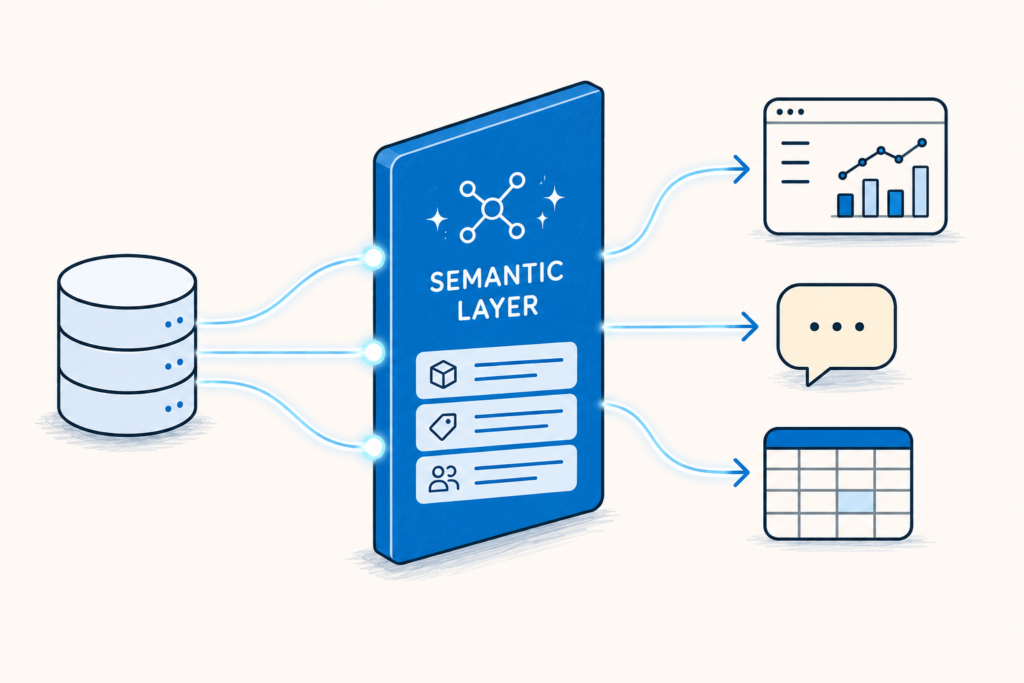
A Semantic Layer is the layer that makes data understandable and usable through shared business meaning. It sits between technical data sources and the people, tools and AI systems that use that data.
It connects technical data structures to the concepts people use in their daily work. It maps tables, columns and calculations to terms such as Customer, Product, Contract, Revenue, Churn, Risk, Cost Centre or Employee.
But a useful Semantic Layer does more than rename technical fields. It gives tools and users access to agreed definitions, metric logic, relationships, rules, trusted sources and ownership. It helps people understand not only where data comes from, but how it should be interpreted and used. In simple terms, a Semantic Layer helps an organisation speak the same data language across reports, dashboards, Data Products and AI Agents.
That may sound straightforward, but it is a powerful idea. Many data problems start when different teams use the same words for different things, or different words for the same thing. Once that happens, every dashboard, report, Data Product and AI solution built on top of those definitions becomes vulnerable to misunderstanding.
Semantic Layer versus Semantic Model
The terms Semantic Layer and Semantic Model are closely related, and different platforms sometimes use them in slightly different ways. Still, there is a useful distinction.
A Semantic Model defines the meaning. It describes business concepts, metrics, dimensions, relationships, calculation logic, rules and trusted sources. It explains what terms such as Customer, Revenue, Churn or Active Customer mean in a specific organisational context.
A Semantic Layer makes that meaning available for use. It exposes the agreed concepts, metrics and rules to the tools and systems that consume data, such as dashboards, notebooks, data catalogues, APIs, Data Products and AI Agents.
In simple terms: the Semantic Model structures the meaning. The Semantic Layer makes that meaning reusable.
For AI Agents, both matter. The agent needs governed meaning, but it also needs a way to access that meaning at the moment it answers a question. That is why the Semantic Layer matters so much. It turns meaning into something that can actually be used across the organisation.
Why AI Agents need governed context
AI Agents stretch the role of the Semantic Layer further. A dashboard usually answers questions that were designed in advance. An AI Agent can receive questions that nobody predicted. It can combine information, explain patterns and suggest next steps. That flexibility is useful, but it also creates risk.
If the agent does not understand the organisation’s language, it may return an answer that sounds confident but rests on the wrong definition, wrong calculation or wrong source. This is why AI does not only need access to data. It needs governed context.
That pattern is visible across the data and analytics market. Vendors increasingly position Semantic Layers and Semantic Models as the place where business meaning, metrics and context are defined, governed and reused. Dbt positions its Semantic Layer as a way to centrally define and query metrics. In dbt, semantic models form the foundation for data definition in the Semantic Layer. Looker describes its semantic layer as a way to translate raw data into language that users and LLMs can understand, with a semantic model at its core for consistent metrics. ThoughtSpot describes the semantic layer as a translation layer between raw data and the systems that query it, enriched with business meaning. Microsoft also warns that poorly prepared Semantic Models can lead to inaccurate or misleading outputs from Copilot.
The wording differs by platform, but the direction is clear. AI needs more than raw access. It needs meaning, rules and context that can be reused at the point of consumption.
Where Data Governance becomes practical
This is where Data Governance becomes very practical. Governance is often mistaken for documentation after the fact. A glossary. A policy. A spreadsheet with owners. Useful, perhaps, but too far removed from the way people actually work.
A Semantic Layer brings governance closer to usage. It gives teams a way to apply approved concepts, calculations, ownership, trusted sources and usage rules across tools. When done well, it becomes part of the route from business question to data answer. This is important because Data Governance only creates real value when it influences how data is used. A definition in a glossary is useful. A definition that also appears in dashboards, Data Products and can be used by AI Agent responses is much more powerful.
This is where platforms such as Collibra can make the concept more concrete. Collibra helps organisations govern business terms, ownership, policies, data assets and lineage, so that shared meaning becomes connected to the actual data landscape instead of sitting separately in documentation.
Example: Governing Active Customer in Collibra
Collibra gives a helpful example of how this can work. Imagine an organisation uses Collibra to govern its most important business terms. One of those terms is Active Customer. At first glance, Active Customer sounds simple. Everyone understands what a customer is, right? Not quite.
Sales may think of an active customer as an account with an open opportunity. Finance may only count customers with invoiced revenue in the current period. Customer Service may look at customers with at least one active support contract. Marketing may include people who interacted with a campaign in the last twelve months.
Each view can be useful. But they are not the same. If an AI Agent is asked, “How many active customers do we have in the Benelux region?”, it needs to know which definition applies.
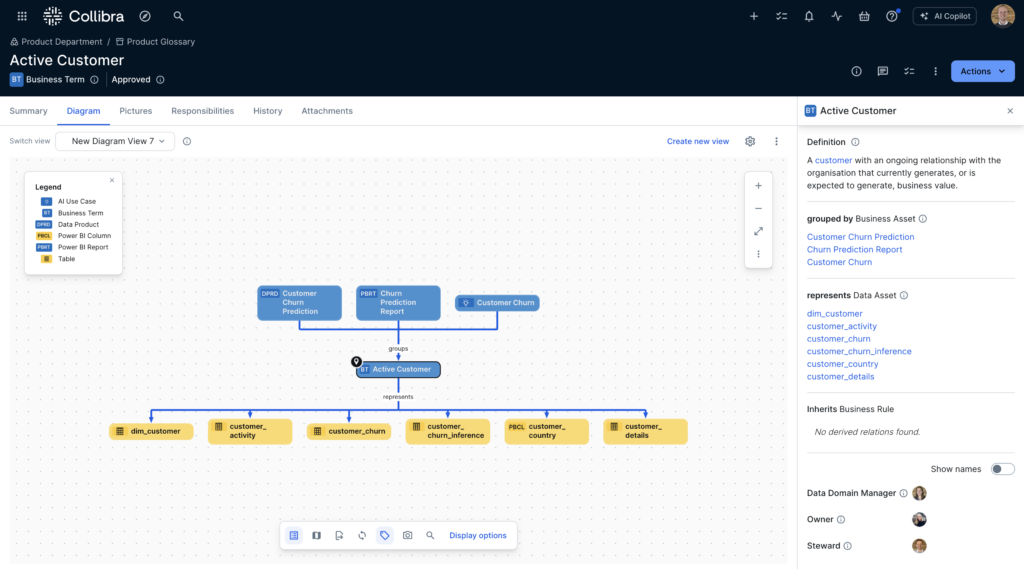
In Collibra, the organisation can make that meaning explicit. The Business Term Active Customer can be created in the Business Glossary with an approved definition, business owner, data steward, status, and relations linking it to the business domain. It can be linked to other business terms such as Customer, Contract, Revenue and Churn. It can also be connected to technical assets such as tables, columns, reports or Data Products.
This governed metadata can support the Semantic Layer. The meaning of Active Customer is no longer hidden in a dashboard formula, an analyst’s SQL script or someone’s head. It becomes governed knowledge that people can find, review and reuse.
To make that knowledge operational, it needs to be connected to the places where data is consumed. That could be a BI platform, a data catalogue, a Data Product, an API, an analytical platform or an AI Agent. That is where the Semantic Layer stops being an abstract concept. It makes governed meaning available where decisions are made.
What changes when an AI Agent answers the question?
Without governed context to answer the question in the example, the AI Agent may search across available datasets and choose for itself. It may select the wrong customer table. It may include inactive customers. It may use the wrong regional hierarchy. It may calculate the quarter differently from the official management report.
With a well maintained Semantic Layer, supported by governed metadata in Collibra and connected to the analytical or AI layer, the AI Agent has a better foundation. It can be designed to work from the approved definition of Active Customer, understand which related assets are trusted, use the documented calculation logic and respect ownership, usage and access rules.
That does not make the agent perfect. Human review, Data Quality checks, access management and AI Governance still matter. But the agent is no longer starting from raw data alone. It is working with governed business meaning that has been made available for use.
The Semantic Layer as a trust layer
This is why the Semantic Layer should not be treated as a technical artefact only. It is part of the bridge between business goals, data solutions and responsible AI. It connects the words people use, the data systems that store information, the processes that govern decisions and the policies that define responsible use.
I like to think of the Semantic Layer as a trust layer for AI Agents. That phrase is a framing, not a formal definition. A Semantic Layer does not magically make every AI answer correct. It does not remove the need for governance, testing, quality controls or human judgement.
But it does make important choices available at the point of use. Which definition do we use? Which calculation is approved? Which source is trusted? Who owns this metric? Which access rules apply? Which context should be considered before answering a question?
How to start building a useful Semantic Layer
A useful Semantic Layer should not try to describe everything at once. If it becomes a dumping ground for every possible field, it becomes hard to maintain and easy to ignore. The strongest starting point is usually a small number of concepts and metrics that matter most.
- Which numbers drive important decisions? Which definitions cause recurring debate? Which reports are used in leadership meetings? Which Data Products are reused across teams? Which AI Agent use cases require trusted answers? Start there.
- Define the terms clearly. Agree on ownership. Link business concepts to the right technical assets. Document calculation logic. Add Data Quality expectations. Include access rules. Capture synonyms and examples where they help users and AI systems interpret questions correctly.
- Then make that meaning available where people and systems actually work. That may be in dashboards, data catalogues, notebooks, Data Products, analytical platforms, APIs or AI Agents.
This is where long term value appears. Not in having a beautiful layer for its own sake, but in reducing confusion, speeding up decision making and helping people trust the answers they receive.
Conclusion
A Semantic Layer helps an organisation turn scattered data into shared, reusable meaning.
For dashboards, that means more consistent reporting. For Data Products, it means better reuse. For Data Governance, it clarifies ownership and accountability at the point of use. For AI Governance, it creates a stronger foundation for responsible AI. For AI Agents, it provides the governed context that reduces guessing.
AI Agents may become a new interface to organisational knowledge. But they can only be as useful as the meaning they can access. If they do not understand the organisation’s language, they will improvise. If they can work with governed definitions, approved metrics and trusted context, they have a much better chance of supporting good decisions.
That is why the Semantic Layer matters. Not as another technical layer. Not as documentation for documentation’s sake. But as the shared meaning layer that connects data, people, process, technology and policy. In an organisation using AI, shared meaning is not a nice extra. It is where trust begins.
At Clever Republic, we help organisations turn Data Governance, Data Intelligence and AI Governance into practical foundations for better decisions. We connect the dots between business terms, data models, technology, processes, ownership and policy, so your organisation can move from scattered definitions to trusted data use.
If you want to build Semantic Layers that people understand, Data Products that teams can reuse and AI Agents that work with the right context, Clever Republic can help you get there. Neem nu contact met ons op!