
In an era of data-driven decision-making, organisations tend to collect and store more data than ever before. Not all data is necessary, and not all stored data creates value. Data Minimisation is a core principle of responsible Data Governance and a legal requirement under the General Data Protection Regulation. Yet many organisations struggle to translate this principle into practice.
What is Data Minimisation?
Data Minimisation is the principle that organisations should: “Collect, process, and retain only the personal data that is necessary for a specific purpose.” Under Article 5(1)(c) of the GDPR, personal data must be “adequate, relevant and limited to what is necessary…”. In simple terms, if you do not need data, you should not collect it. If you no longer need it, you should not keep it.
Why is Data Minimisation important
Not only is Data Minimisation a compliance obligation, but it also directly affects other areas:
- Privacy protection: Less stored data reduces exposure in case of a data breach.
- Regulatory risk: Excessive data collection increases GDPR compliance risks.
- Data security: The more data you store, the larger your attack surface.
- Operational efficiency: Unnecessary data increases storage and management costs.
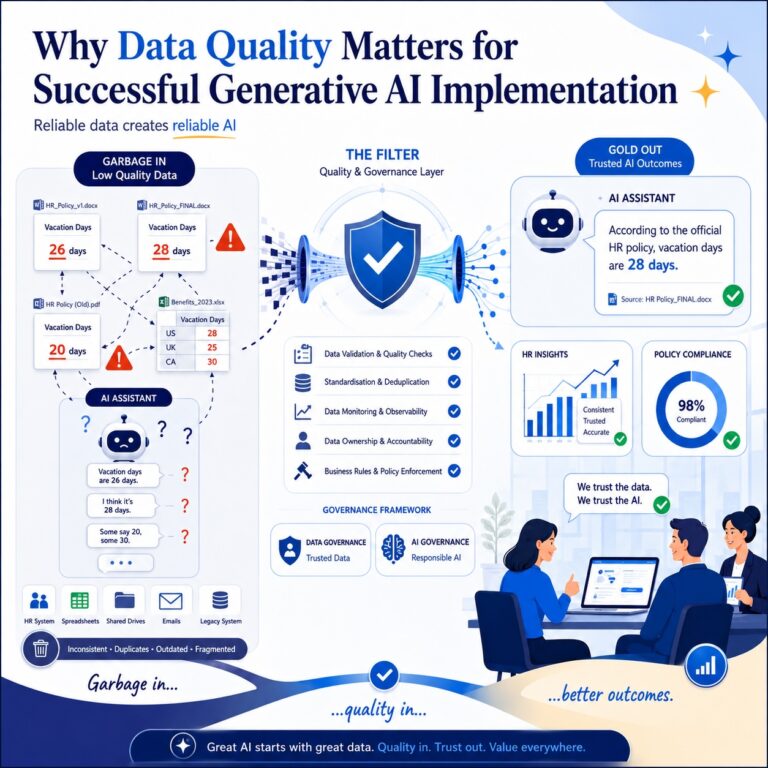
- Data quality: Smaller, well-defined datasets are often more reliable and manageable, because reducing noise improves clarity.
Why organisations struggle with Data Minimisation under GDPR
Although Data Minimisation appears straightforward as a legal principle, translating it into operational practice can be anything but simple.
The first challenge often lies in defining the purpose of data processing with sufficient precision. Often organisations formulate purposes too broadly, like “improving customer experience”, or “optimising performance”. They don’t specify what the action requires in terms of concrete data elements.
At the same time, organisations frequently lack a complete overview of the data they hold. Data inventories can be outdated or fragmented. In such environments data accumulates over time without clear understanding of where it resides or why it is retained.
There are also cultural dynamics at play. Business units are often reluctant to delete data because it “might become useful”. Analytical teams prefer to retain large datasets to enable future insights, while compliance teams push for stricter limitation. These conflicting incentives create internal tension around what responsible data means.
Finally, data ownership is frequently unclear. When no individual or function is explicitly accountable for lifecycle decisions, deletion becomes everyone’s responsibility and therefore no one’s.
Moving from principle to practise
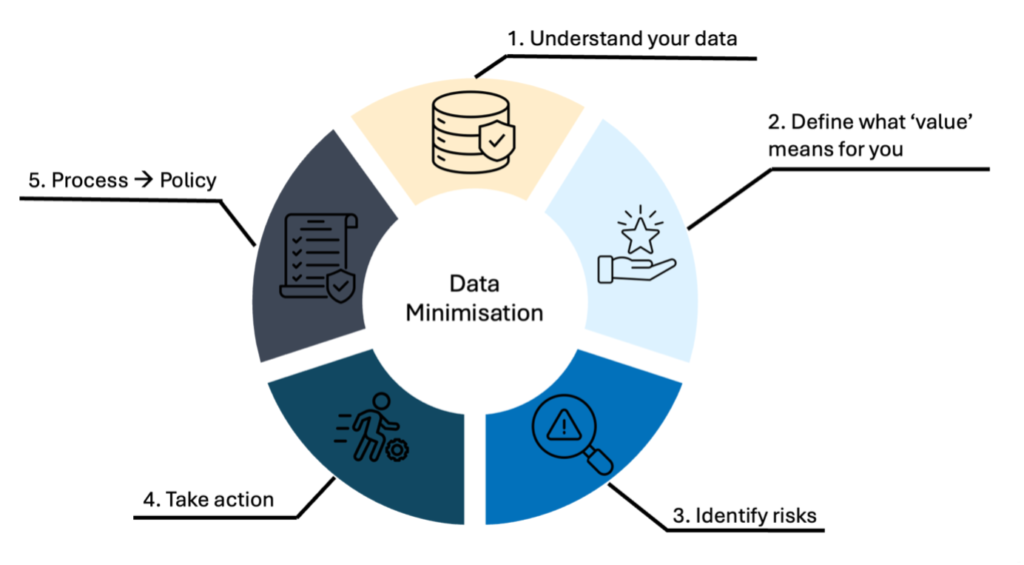
Understanding Data Minimisation as a legal principle is only the first step. The real challenge lies in translating the abstract requirement “data must be limited to what is necessary” into concrete organisational decisions. A practical approach can be visualised in five interconnected steps.
1. Understand your data
Minimisation begins with visibility. Organisations need to develop a clear overview of what data they collect, where it’s stored, how it flows and who has access to it. Without a reliable data inventory and data mapping exercise, minimisation decisions are based on assumptions rather than facts.
2. Define what value means for your organisation
Not all data creates equal value. Organisations need to explicitly define what business, analytical or compliance value means in their specific context. This
step creates an important discussion. Which data elements are truly necessary for their defined purpose, and which are collected “just in case”? Minimisation is a value judgement, without clarity on value, necessity cannot be assessed.
3. Identify risks
Data that is not strictly necessary increases exposure. At this stage, organisations assess:
- Regulatory risks (GDPR compliance exposure)
- Security risks (attack surface)
- Reputational risks
- Operational efficiency
This risk lens helps prioritise action and creates alignment between legal, IT, and business stakeholders.
4. Take action
Minimisation only becomes real when technical and organisational measures are implemented. At this stage, governance decisions are translated into system design and operational processes.
5. Embed minimisation into policy and process
Finally, minimisation must move beyond a one-off project. It needs to be embedded in:
- Data Governance frameworks
- Change management processes
- Privacy by design practices
- Procurement and system development cycles
Only when minimisation becomes part of standard operating procedures does it move from reactive compliance to sustainable governance.
Conclusion
Data Minimisation is a fundamental principle of GDPR and a key element of responsible Data Governance. It requires organisations to critically assess what personal data they collect and retain, whether truly necessary for a defined purpose. While the principle itself is straightforward, implementing Data Minimisation in practice requires clear accountability and structured decision-making. Organisations that approach Data Minimisation systematically are better positioned to reduce regulatory risk and improve data quality, while managing data in a responsible and sustainable way.
Is your organisation struggling to operationalise data minimisation under GDPR? Clever Republic helps organisations translate data governance principles into practical, scalable solutions. Feel free to get in touch to explore how data minimisation can be embedded into your governance framework.