
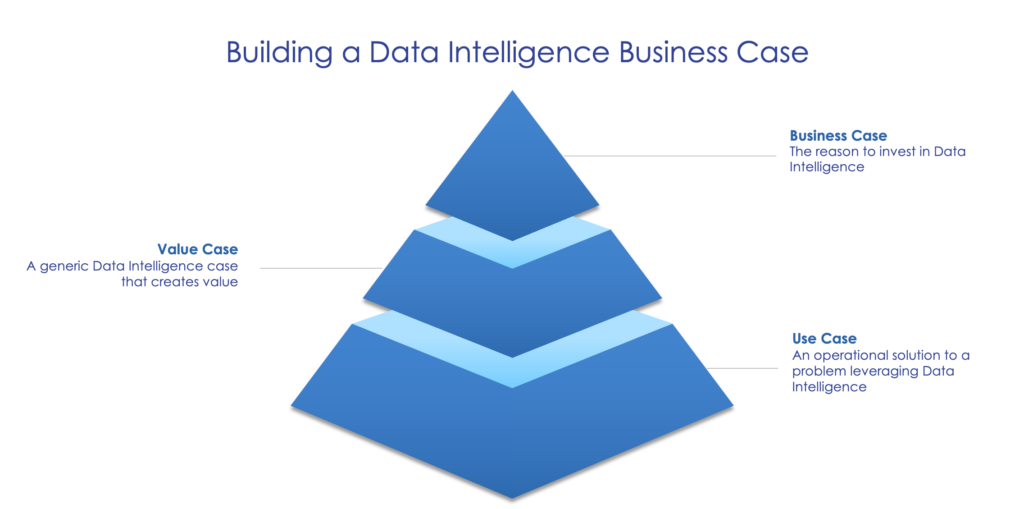
Most organisations say they want to be data-driven. What they often struggle with is explaining how everyday data work connects to real business outcomes. The Data Intelligence value pyramid exists to solve that problem. The pyramid tells a simple, bottom-up story. It starts with practical use cases that teams implement. Those use cases combine into value cases that describe how value is created. Together, they deliver the business outcomes leaders care about (e.g., compliance, efficiency, and decision-making). When the pyramid is used correctly, every data initiative has a clear reason to exist and a clear line of sight to business value.
Starting at the bottom: Use cases
Use cases form the foundation of the pyramid because this is where real work happens. A use case is a clearly defined, practical solution to a specific data-related problem. It has a clear scope, a clear owner, and a clear outcome. Someone can build it, use it, and tell whether it is working or not. Good use cases are grounded in reality. They usually start with friction: people cannot find data, do not trust it, cannot access it, or cannot explain it. A use case exists to remove one of those blockers. For example, a use case might focus on setting up controlled access to sensitive datasets, documenting where a critical report gets its numbers from, improving the quality of a dataset used for monthly reporting, or defining and maintaining reference data that many teams depend on.
What all use cases have in common is that they are deliberately narrow. They are not meant to change the organisation on their own. Their job is to make one thing better in a measurable way. That narrowness is a strength. It allows teams to deliver incrementally, learn quickly, and show progress. Over time, many small, well-executed use cases create momentum. Use cases are also where accountability lives. Someone owns them, maintains them, and is responsible for keeping them useful. Without this foundation, everything above the base of the pyramid becomes theoretical.
How use cases add up: Value cases
Value cases sit in the middle of the pyramid for a reason. They are not abstract strategy, and they are not hands-on execution. They describe the kind of value an organisation repeatedly creates when it uses data well. A value case is best understood as a capability the organisation builds over time. It is stable enough to matter beyond a single project, but concrete enough that teams know what they are trying to improve.
Instead of asking, “What are we building?”, value cases ask, “What gets better, consistently, when we do this well?”
Some value cases are about control and confidence in how data is handled. These include things like privacy management, policy enforcement, governed data sharing, and transparency around how data and models are used. When these value cases are in place, people know the rules, responsibilities are clear, and data use is defensible. Other value cases are about reducing friction in everyday work. These focus on clarity and reuse: clear ownership, well-defined reference data, trusted datasets that others can rely on, and a shared business language. When these value cases are strong, teams stop reinventing the same things and move faster with less coordination overhead. There are also value cases centered on trust in analytics and reporting. These emphasise Data Quality, traceability, and consistency. When these value cases are present, numbers can be explained, reports align with each other, and discussions shift from questioning the data to acting on it.
What matters is that value cases are persistent. Individual use cases may come and go, but value cases describe the lasting improvements the organisation wants to embed into how it works with data. They also provide a natural way to organise work. Instead of managing dozens of disconnected initiatives, teams can group efforts under a small number of value cases and clearly articulate what capability is being strengthened.
Where it all leads: The business case
At the top of the pyramid sits the business case. This is the simplest way to explain why an organisation is investing in Data Intelligence. It is the story leaders need in order to make a decision: what problem are we solving at an organisational level, what improves if we invest, and why now. In the pyramid, the business case is often framed through three familiar options: Compliance, Efficiency, and Decision-making. Different organisations emphasise different ones, and many choose a mix depending on their priorities.
Compliance is the option you lead with when risk is the main concern. The business case centres on being able to demonstrate control over data, reduce exposure, and avoid costly mistakes. Efficiency is the option you lead with when speed and scale matter most. The business case centres on reducing wasted effort, shortening delivery cycles, and making better use of existing data assets. Decision-making is the option you lead with when alignment and confidence are the priority. The business case centres on ensuring people trust the numbers, speak the same language, and can act without long debates about what is true.
What makes this top layer powerful is that it stays high-level and easy to repeat. It gives the organisation a clear reason to invest, while leaving the detailed “how” to the layers underneath.
Reading the pyramid from bottom to top
The real power of the Data Intelligence value pyramid is that it keeps everyone aligned. Teams on the ground can point to a specific use case and explain which value case it supports. Data leaders can show how those value cases map to the company’s business case: its reason to invest in Data Intelligence. Executives can see how investment translates into outcomes.
A healthy pyramid reads like this: We implement targeted use cases. Those use cases reinforce a small number of value cases. Together, those value cases deliver the business case. When that chain is clear, prioritisation gets easier, conversations get simpler, and data work stops feeling abstract.
Why this framing works
The pyramid works because it respects how organisations actually operate. Value is not created in one big leap. It is built incrementally, through practical solutions that compound over time. By starting at the bottom and keeping a clear line to the top, the Data Intelligence value pyramid turns Data Intelligence from a collection of activities into a coherent story. A story that teams can execute, leaders can fund, and the business can feel. That’s the real value of the pyramid.
Ready to build your Data Intelligence value pyramid?
If your organisation recognises this struggle, you are not alone. Most teams have plenty of data activity, but they lack a shared story that connects everyday work to outcomes leaders actually care about. That is exactly what we help fix.
Clever Republic helps organisations design and implement the Data Intelligence value pyramid in a practical way. We work with your teams to identify high impact use cases, cluster them into a manageable set of value cases, and translate that into a business case. Then we help you operationalise it with the right mix of People, Process, Technology, and Policy, so it does not stay a slide, but becomes how your organisation works with data.
If you want a clear line of sight from data work to business value, we would love to help. Get in touch with us and we can explore what your pyramid could look like.